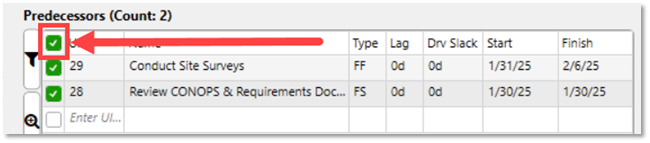
Each row in this table represents a predecessor activity linked to the currently selected activity. The columns provide two types of information: attributes of the predecessor task itself—such as UID and Name—and details about the dependency relationship between the predecessor and the selected task—such as Type, Lag, and Driving Slack. You can quickly navigate the schedule to any of the predecessor activities displayed by double clicking on any cell in its row in the table.
Columns with an asterisk (*) at the end of the header indicate that the field is editable within the Predecessor Table. The following fields are editable in the Predecessors Table: Unique ID, ID, Type, and Lag.
The fields visible in this table can be adjusted to your liking through the Dependency Tracer Configuration
This column displays how much Driving Slack each predecessor has to the currently selected task. These values are calculated in real time by the Dependency Tracer and are not pulled from any existing field in Microsoft Project. Additionally, the Dependency Tracer does not write these values in any task field within the project file.
Predecessor activities in the Predecessors Table are always sorted by the amount of Driving Slack they have to the currently selected activity, with those having the least driving slack appearing at the top, and those with the most at the bottom.
If Driving Slack is ever calculated as a negative number, it indicates an Out-of-Sequence dependency relationship between the predecessor activity and the currently selected task.
Clicking this button will filter the Gantt Chart for the currently selected task and any checked predecessors in the Predecessors Table. This button clears any other existing filters.
Clicking this button will add the checked predecessors in the Predecessors Table into the current filter in the Gantt Chart if they are not already included. Unlike the filter button, this button does not remove any existing filters, instead it adds additional content into them.
Clicking this button will remove the checked predecessors from the Predecessors Table view. This action only removes them from the interface itself. The actual predecessor relationships are not deleted from the currently selected task in Microsoft Project until the Accept button is clicked.
Clicking this button will Export the checked predecessors from the Predecessors Table to an Excel spreadsheet. The export will automatically open in Excel once it is completed.