Directional Path Definitions
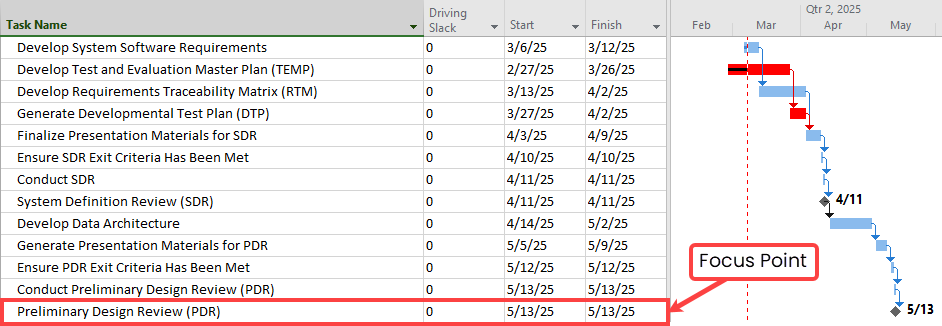
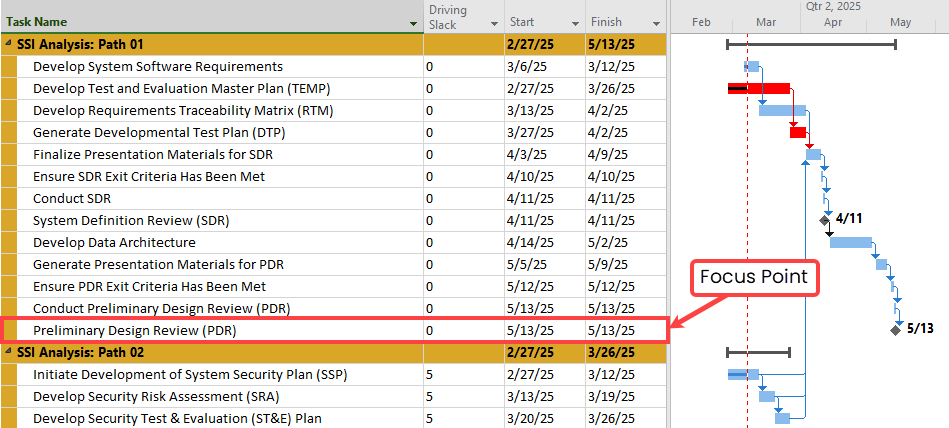
Focus Point
In the context of the Directional Path Tool, a focus point refers to any task or milestone in the schedule that is selected as the starting point for a directional path analysis at the time the analysis is conducted.
Directional Path
SSI defines a Directional Path as a sequence of logically connected activities that extend from a designated focus point in a single direction - either backward to preceding tasks or forward to succeeding ones.
Backward Path
SSI defines a Backward Path as a set of activities that precede and are logically linked to a focus point. These activities may or may not directly drive the focus point and can possess any amount of Driving Slack relative to it. A Backward Path can be configured to include either all preceding activities or only those within a specified Driving Slack threshold.
Forward Path
SSI defines a Forward Path as a set of activities that succeed and are logically connected to a focus point. The focus point itself may or may not drive these successor activities and can have any amount of Driving Slack relative to them. A Forward Path can be configured to include either all succeeding activities or only those within a specified Driving Slack threshold.
Critical Path
SSI defines the Critical Path as the set of activities that directly drive the start or finish of the project’s final task or milestone. Each of these tasks have zero days of Driving Slack to the latest activity, meaning any delay to these activities will immediately cause a delay to the overall project completion date. A project’s critical path is the same as a Backward Path with a Driving Slack limit of zero, where the focus point selected is the latest activity in the schedule.
Driving Path
SSI defines A Driving Path as the set of activities that are driving a focus point (not necessarily the latest activity) to its current start or finish date. Each of these activities have zero days of Driving Slack to the focus point, meaning any delay to any of these activities will immediately cause the focus point to be delayed. A Driving Path is equivalent to a Backward Path configured with a Driving Slack limit of zero to the focus point. This path may also be referred to as the Primary Driving Path.
Driven Path
SSI defines A Driven Path as the set of activities whose current start or finish dates are directly driven by a focus point. The focus point has zero days of Driving Slack to each of these activities, meaning any delay to the focus point would immediately cause a delay to each of the activities on the driven path. A Driven Path is equivalent to a Forward Path configured with a Driving Slack limit of zero from the focus point. This path can also be referred to as the Primary Driven Path.
Near Driving Path
SSI defines a Near Driving Path as a set of activities that have limited schedule flexibility before they begin to directly drive a focus point to its current start or finish date. These tasks have one or more days of Driving Slack to the focus point, allowing some delay without immediately driving it.
A Near Driving Path may be defined as the set of tasks closest to the Primary Driving Path or prior Near Driving Path, or as any activities falling within a defined range of Driving Slack values. The first Near Driving Path following the Primary Driving Path is referred to as the Secondary Driving Path, and the one after that is known as the Tertiary Driving Path.
Near Driven Path
SSI defines a Near Driven Path as a set of activities which a specific focus has limited schedule flexibility before it begins to drive them to their current start or finish dates. The focus point will have one or more days of Driving Slack to these activities.
A Near Driven Path may be defined as the set of tasks the focus point is next closest to driving after the Primary Driven Path or prior Near Driven Path, or as any activities that the focus point has a defined range of Driving Slack values to. The first Near Driven Path following the Primary Driven Path is referred to as the Secondary Driven Path, and the one after that is known as the Tertiary Driven Path.
Driving Path Drag
SSI defines Driving Path Drag as the amount of opportunity (measured in days) an activity on a Primary Driving Path has to accelerate the current start or finish of the path’s focus point if the activity’s remaining duration were cut to zero.