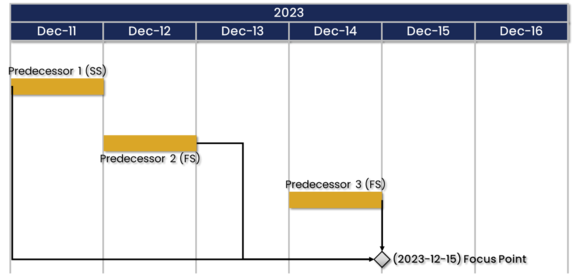
Driving Slack is the amount of schedule flexibility (also known as slack or float) activities in a dependency chain have before they would begin to drive a specific focus point. In other words, it is the amount of time an activity’s Start or Finish (depending on the dependency type) can be delayed before it begins to drive the focus point’s current Start or Finish dates. A focus point refers to any task or milestone in the schedule that is selected as the starting point for analysis.
Unlike Free Slack or Total Slack, Driving Slack is not calculated or displayed by Microsoft Project. However, it is a meaningful and measurable concept that can be derived by analyzing the logical relationships between connected activities. Evaluating Driving Slack is the most accurate method for identifying true driving activities.
Understanding the differences between Driving Slack, Free Slack, and Total Slack is essential knowledge for any project scheduler to accurately interpret activity flexibility and schedule impacts.
Driving Slack refers to amount of schedule flexibility activities logically connected to a focus point have before they would begin to drive it to its current dates. The “focus point” can be any task or milestone in the schedule and is determined at the time of the analysis. Activities not logically connected to the focus point will not have a driving slack value.
Free Slack refers to the amount of schedule flexibility a task has relative to its nearest successor. Unlike Driving Slack, Free Slack does not account for whether the successor is part of a chain leading to the analysis focus point. As a result, a task’s nearest successor may have no logical connection to the focus point.
Total Slack represents the amount of schedule flexibility a task has before it affects either a downstream task with a defined deadline or, if no deadlines exist in the workstream, the final task in the project. Total slack is useful for measuring how much time activities can be delayed without impacting critical deliveries or the end date of the project.
Understanding how Driving Slack is calculated is key to understanding how SSI’s Dependency Analysis Tools work.
In the diagram above, a milestone is being used as the focus point. To calculate Driving Slack, the distance (in time) between the ______ of the predecessor task and the ______ of the focus point is measured. The blanks are filled with either Start or Finish based on the dependency type.
Predecessor 1 has a Start-to-Start relationship with the milestone, so Driving Slack is calculated by measuring the time between the start of Predecessor 1 and the start of the milestone. This gives a Driving Slack value of 4 days.
Predecessor 2 has a Finish-to-Start relationship with the milestone. Therefore, Driving Slack is the time between the finish of Predecessor 2 and the start of the milestone, which is 2 days.
Predecessor 3 also has a Finish-to-Start relationship with the milestone. Since Predecessor 3 finishes at the same time the milestone is scheduled to start, the Driving Slack is 0 days.
When a task has 0 days of Driving Slack to a focus point, it means the task is directly driving the start or finish of that activity—any delay in that task will immediately delay the focus point as well.
All SSI Dependency Analysis tools calculate Driving Slack. The Directional Path Tool relies on the calculation of Driving Slack to perform its analyses.